
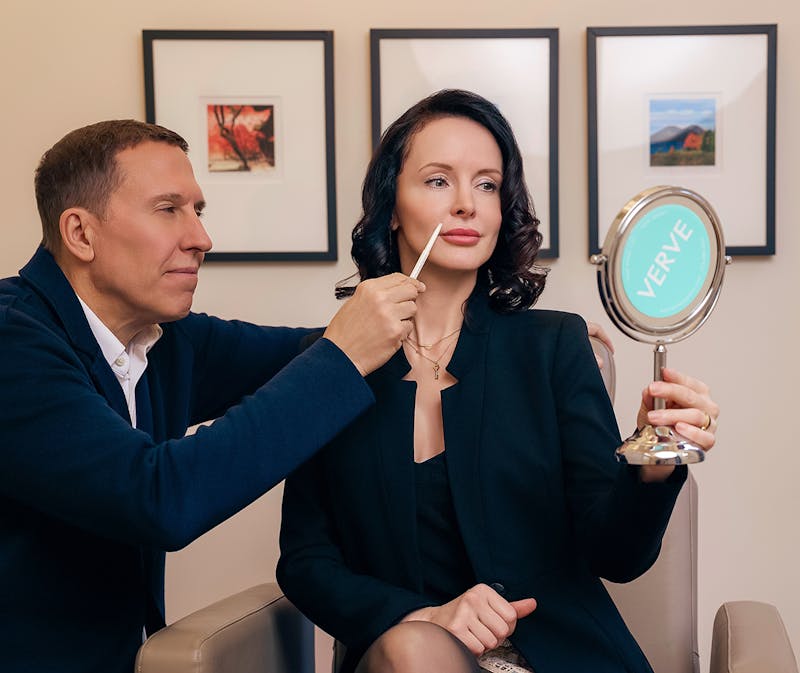
Thinning lips aren’t simply about missing volume. As lips age, they undergo changes in thickness, shape, support, muscle, collagen, and the way the lip tissue is distributed. At VERVE Medical Cosmetics, Dr. Stephen Bracci approaches structural lip restoration and lip filler in Manhattan and Paramus by rebuilding natural lip support and contour rather than injecting for size alone.
Dr. Bracci is a board-certified physician with more than 26 years of experience focused exclusively on cosmetic injectables, having personally performed over 50,000 filler procedures. As VERVE’s sole provider, he treats every patient himself, with no rotating staff or standardized protocols. He is a member of the American Board of Laser Surgery, the Aesthetic Multispecialty Society, and the American Medical Association.
That depth of experience shapes how he approaches lips specifically. Rather than treating them as a canvas for added bulk, Dr. Bracci evaluates the border, columns, contour, and proportion that define a well-supported lip. The goal is natural lip contour and definition without creating an overfilled appearance.
Why Do Lips Lose Structure as We Age?
Lip aging is more complicated than simply saying that the lips “shrink.” Research suggests that aging lips undergo a combination of structural changes, including decreased thickness, lengthening of the upper lip, reduced visible vermilion, changes in the orbicularis oris muscle, and degeneration of collagen and elastic fibers. Some studies describe this as a redistribution from thickness to length rather than a straightforward loss of total lip volume.
Anatomical research also demonstrates distinct fat beneath the orbicularis oris muscle, supporting the importance of understanding the deeper structural anatomy of the lip when planning rejuvenation.
Several changes contribute to the appearance of aging lips:
- Reduced collagen production, which weakens the connective tissue that helps maintain definition
- Changes in the deeper fat and soft-tissue support of the lips
- Thinning and age-related changes of the orbicularis oris muscle, which can affect lip shape and projection
- Sun exposure, which accelerates the breakdown of existing collagen
- Flattening or reduced definition of structural landmarks such as the vermilion border, philtrum columns, and Cupid’s bow
- Lengthening and inversion of the upper lip, which can make less of the natural vermilion visible
According to UCLA Health, collagen production decreases by about 1% per year beginning in early adulthood. Over decades, that gradual decline contributes to changes in the skin and connective tissue that help define a youthful lip.
What’s the Difference Between Adding Volume and Restoring Lip Structure?
Adding volume means injecting filler primarily to enlarge the lips. Restoring lip structure means evaluating and rebuilding the specific areas that create natural shape, contour, projection, and proportion.
Many injectable approaches focus predominantly on volume. Dr. Bracci’s structural approach at VERVE evaluates several elements before treatment begins:
The two main parts of the lip for consideration:
- The vermilion border, or the defined edge between the lip and the surrounding skin
- The body of the lip
The details of the lip -
- The philtrum columns, the two vertical ridges above the upper lip
- The Cupid’s bow, which shapes the center of the upper lip
- The ratio between the upper and lower lip
- How the lips relate to the rest of the lower face
Research on aging lips supports evaluating these individual structural landmarks rather than thinking about lip aging solely as a problem of volume.
Restoring these elements can create definition and a more natural lip contour. Simply adding volume without considering structure and proportion can contribute to the overfilled appearance that many patients want to avoid.
How Does Lip Filler Restore Structural Support?
Lip filler can be used to restore structural support by addressing the lip’s border and body as well as the columns, shape, and areas of lost fullness rather than simply adding bulk to the center.
Dr. Bracci uses hyaluronic acid fillers placed precisely according to the patient’s anatomy and treatment goals.
Structural lip filler at VERVE may address several distinct areas:
- The vermilion border, to restore a crisp, defined edge
- The body of the lip, when additional fullness is appropriate
- The philtrum columns, to reestablish the vertical ridges above the upper lip ● The Cupid’s bow, to refine the shape at the center of the upper lip
- Areas requiring improved symmetry, projection, or proportion
Contemporary anatomical research also supports the concept that deeper, anatomy-guided augmentation can restore lip eversion and support while preserving important landmarks such as the vermilion border and Cupid’s bow.
Because filler is placed according to each patient’s existing anatomy, the objective is proportion rather than exaggeration. The goal is a lip that looks like a better-supported, more defined version of the patient’s own lips.
How Does a Lip Flip Refine Shape Without Adding Size?
A lip flip refines lip shape by using a small amount of a wrinkle relaxer to relax portions of the orbicularis oris muscle, allowing the upper lip to roll slightly outward without adding filler volume.
Unlike filler, a lip flip does not add bulk. It can allow more of the natural upper lip to show and may be appropriate when a patient wants a subtle change in shape rather than additional size.
Patients may consider a lip flip for:
- A softer, more relaxed smile line
- A more visible upper lip without adding filler volume
- A smaller change before considering filler
- Subtle refinement when additional volume is not desired
Dr. Bracci evaluates whether a lip flip, structural lip filler, or a combination of both is most appropriate for each patient’s anatomy and goals.
Why Choose Dr. Bracci and VERVE for Structural Lip Restoration in Manhattan and Paramus?
Natural-looking lip restoration requires more than simply choosing how much filler to inject. It requires evaluating how the lip has changed and deciding which structural elements actually need treatment.
Dr. Stephen Bracci brings more than 26 years of dedicated experience in cosmetic injectables to every structural lip restoration and lip filler treatment performed at VERVE Medical Cosmetics in Manhattan and Paramus. As a solo provider, he personally performs every procedure, allowing for consistency and an individualized approach.
His approach to lip restoration reflects the same structural philosophy behind VERVE’s facial treatments: understand what has changed, restore support where appropriate, and avoid adding unnecessary volume.
Patients seeking lip filler, structural lip restoration, or a lip flip in Manhattan or Paramus can be treated with an approach designed around natural lip contour, definition, balance, and proportion, while avoiding the overfilled look.
Schedule a private consultation with Dr. Stephen Bracci at VERVE Medical Cosmetics to determine whether structural lip filler, a lip flip, or a combination of both is appropriate for your lips.
Disclaimer: This information is provided for educational purposes only and does not replace a consultation with a qualified physician. Outcomes, risks, and suitability vary from patient to patient.
Sources
Penna V, Stark GB, Eisenhardt SU, Bannasch H, Iblher N. The Aging Lip: A Comparative Histological Analysis of Age-Related Changes in the Upper Lip Complex. Plastic and Reconstructive Surgery. 2009;124(2):624–628.
Iblher N, Kloepper J, Penna V, Bartholomae JP, Stark GB. Changes in the Aging Upper Lip—A Photomorphometric and MRI-Based Study (On a Quest to Find the Right Rejuvenation Approach). Journal of Plastic, Reconstructive & Aesthetic Surgery. 2008;61(10):1170–1176.
Rohrich RJ, Pessa JE. The Anatomy and Clinical Implications of Perioral Submuscular Fat. Plastic and Reconstructive Surgery. 2009.
Penna V, Stark GB, Voigt M, Mehlhorn A, Iblher N. Classification of the Aging Lips: A Foundation for an Integrated Approach to Perioral Rejuvenation. Aesthetic Plastic Surgery. 2015;39(1):1–7.
UCLA Health. Should You Take Collagen Supplements?